

Hey there! As an Aluminum Alloy Guide Rail supplier, I'm super excited to walk you through the production processes of these awesome guide rails. Aluminum alloy guide rails are widely used in various industries, like solar energy, construction, and machinery. They're known for their lightweight, corrosion resistance, and high strength, which makes them a top choice for many applications.
1. Raw Material Selection
The first step in making aluminum alloy guide rails is choosing the right raw materials. Aluminum alloys are made by combining aluminum with other elements like copper, magnesium, silicon, and zinc. The specific alloy composition depends on the desired properties of the guide rail. For example, if you need a guide rail with high strength, you might choose an alloy with a higher copper content.
We source our raw materials from trusted suppliers who meet our strict quality standards. We test the raw materials to ensure they have the right chemical composition and mechanical properties. This helps us make sure that our guide rails are of the highest quality.
2. Melting and Casting
Once we have the raw materials, it's time to melt them down. We use a furnace to heat the aluminum alloy to a high temperature until it becomes molten. During the melting process, we add other elements to the molten aluminum to achieve the desired alloy composition. We also use various techniques to remove impurities from the molten metal, such as degassing and filtering.
After the molten aluminum is ready, we pour it into a mold to form the shape of the guide rail. There are different casting methods we can use, such as die casting, sand casting, and continuous casting. Die casting is a popular method for making aluminum alloy guide rails because it allows us to produce complex shapes with high precision.
3. Extrusion
After the casting process, the guide rail is in a rough shape. To get the final shape and dimensions, we use the extrusion process. Extrusion is a process where we force the aluminum alloy through a die to create a specific shape. The die is a tool with a hole in the shape of the desired guide rail cross-section.
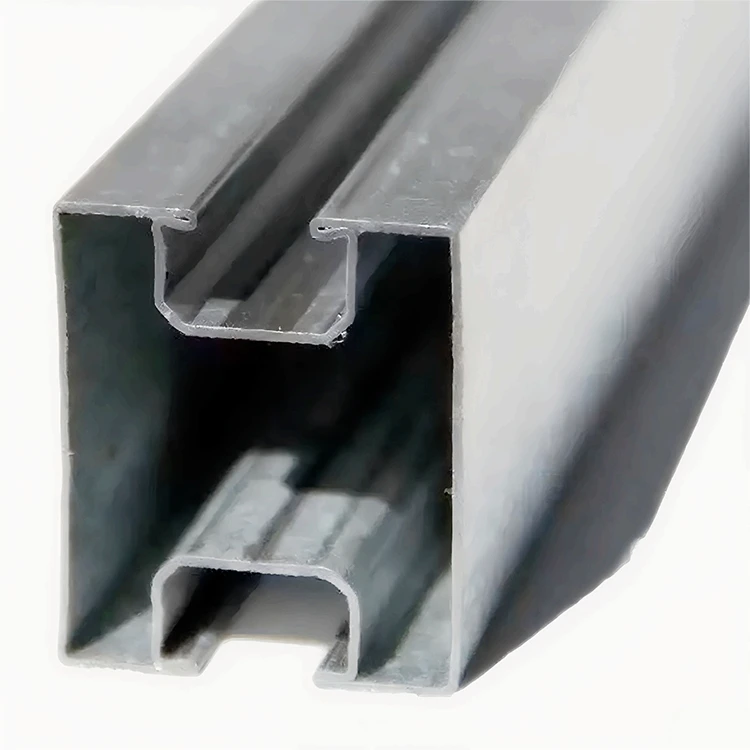

We heat the cast aluminum alloy to a specific temperature and then use a hydraulic press to push it through the die. As the aluminum alloy passes through the die, it takes on the shape of the die and becomes a long, continuous piece of guide rail. The extrusion process allows us to produce guide rails with consistent cross-sections and high surface quality.
4. Heat Treatment
Heat treatment is an important step in the production of aluminum alloy guide rails. It helps to improve the mechanical properties of the guide rail, such as strength, hardness, and toughness. There are different types of heat treatment processes we can use, such as annealing, quenching, and tempering.
Annealing is a process where we heat the guide rail to a specific temperature and then cool it slowly. This helps to relieve internal stresses in the guide rail and make it more ductile. Quenching is a process where we heat the guide rail to a high temperature and then cool it rapidly. This helps to increase the hardness and strength of the guide rail. Tempering is a process where we heat the quenched guide rail to a lower temperature and then cool it slowly. This helps to reduce the brittleness of the guide rail and improve its toughness.
5. Machining
After the heat treatment process, the guide rail may need some additional machining to achieve the final dimensions and surface finish. Machining is a process where we use cutting tools to remove material from the guide rail. There are different types of machining operations we can use, such as milling, turning, drilling, and grinding.
Milling is a process where we use a rotating cutter to remove material from the surface of the guide rail. Turning is a process where we use a lathe to rotate the guide rail and a cutting tool to remove material from the outer diameter. Drilling is a process where we use a drill bit to create holes in the guide rail. Grinding is a process where we use a grinding wheel to remove material from the surface of the guide rail and achieve a smooth finish.
6. Surface Treatment
Surface treatment is an important step in the production of aluminum alloy guide rails. It helps to protect the guide rail from corrosion and improve its appearance. There are different types of surface treatment processes we can use, such as anodizing, powder coating, and painting.
Anodizing is a process where we create a thin oxide layer on the surface of the guide rail by immersing it in an electrolyte solution and applying an electric current. The oxide layer helps to protect the guide rail from corrosion and improve its wear resistance. Powder coating is a process where we apply a dry powder to the surface of the guide rail and then heat it to melt the powder and form a smooth, durable coating. Painting is a process where we apply a liquid paint to the surface of the guide rail to protect it from corrosion and improve its appearance.
7. Quality Control
Quality control is an important part of the production process. We have a strict quality control system in place to ensure that our guide rails meet the highest quality standards. We use various testing methods to check the quality of the guide rails, such as visual inspection, dimensional measurement, mechanical testing, and chemical analysis.
Visual inspection is a simple but effective method for checking the surface quality of the guide rail. We look for any defects, such as cracks, scratches, and porosity. Dimensional measurement is a method for checking the dimensions of the guide rail to make sure it meets the specifications. Mechanical testing is a method for checking the mechanical properties of the guide rail, such as strength, hardness, and toughness. Chemical analysis is a method for checking the chemical composition of the guide rail to make sure it meets the desired alloy composition.
8. Packaging and Shipping
Once the guide rails pass the quality control tests, it's time to package them for shipping. We use different packaging materials to protect the guide rails during transportation, such as plastic bags, wooden crates, and cardboard boxes. We also label the packages with important information, such as the product name, dimensions, quantity, and destination.
We work with reliable shipping companies to ensure that our guide rails are delivered to our customers on time and in good condition. We offer different shipping options, such as air freight, sea freight, and land transportation, depending on the customer's requirements.
Our Product Range
We offer a wide range of aluminum alloy guide rails to meet the needs of different industries. Some of our popular products include Solar Panel Aluminum Guide Rail, Solar Mounting Rail Solar Panel Mounting Rail Aluminum Alloy Rail, and Zinc-Aluminum-Magnesium Guide Rail. These guide rails are designed to be lightweight, corrosion-resistant, and easy to install.
Contact Us for Purchasing
If you're interested in our aluminum alloy guide rails, we'd love to hear from you. Whether you need a small quantity for a DIY project or a large order for an industrial application, we can help. We're committed to providing our customers with high-quality products and excellent customer service. So, don't hesitate to reach out to us for more information or to start a purchasing discussion.
References
- ASM Handbook Committee. (2000). ASM Handbook Volume 14A: Metalworking: Bulk Forming. ASM International.
- Davis, J. R. (Ed.). (2001). Aluminum and Aluminum Alloys. ASM International.
- Kalpakjian, S., & Schmid, S. R. (2008). Manufacturing Engineering and Technology. Pearson Prentice Hall.